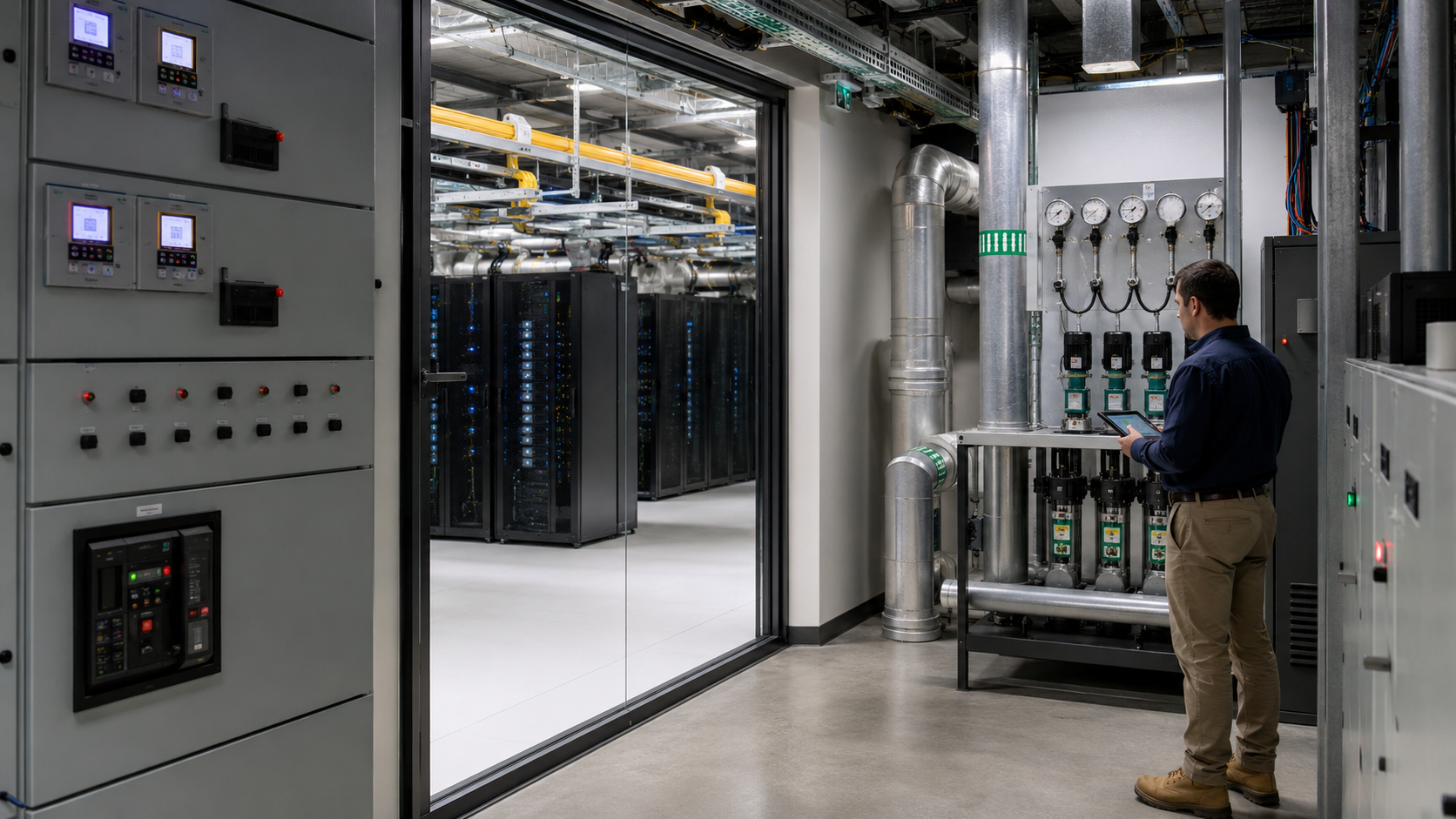

Most data centres collect large volumes of operational data. The harder question is whether the right measurements are available, trustworthy and connected well enough to expose energy losses, cooling problems and developing faults.
A useful monitoring strategy does more than add sensors. It identifies the decisions the facility team needs to make, confirms where measurement gaps exist, and produces information that can be reconciled across electrical, mechanical and BMS systems.
Why visibility gaps matter
Small discrepancies can become expensive when multiplied across high electrical loads and continuously operating cooling plant. A meter that does not agree with an upstream reference, a drifting differential-pressure sensor or an unmonitored coolant circuit may conceal unnecessary consumption or an emerging reliability problem.
- Electrical data may be available only at a main incomer, with insufficient detail to identify the load creating the change.
- Power, cooling and environmental readings may sit in separate systems with inconsistent timestamps or naming.
- A BMS value may appear plausible even when the sensor range, tubing, installation or calibration is unsuitable.
- Cooling-water pressure and flow problems may be detected only after temperatures rise or equipment alarms.
- Temporary commissioning meters may reveal a discrepancy that permanent monitoring cannot explain.
Four measurement layers to review
1. Granular electrical submetering
Whole-site consumption is important, but load-level data is what helps isolate change. The Setra networked multi-load power meter is available for 3, 12 or 48 loads and can monitor combinations of single-phase and three-phase circuits. The 12- and 48-load versions support dual-voltage inputs, while standard or Rogowski-style current transformers can be selected to suit the application.
BACnet and Modbus communications support integration with energy-management and building systems. Local data logging can also assist commissioning, troubleshooting and reconciliation when the upstream platform is unavailable or a historical comparison is required.
2. Airside pressure and environmental conditions
Low differential-pressure measurements support hot-aisle and cold-aisle containment, raised-floor control, plenum pressure, filter condition, airflow stations and fan control. Temperature and relative-humidity measurements provide the environmental context needed to understand whether pressure and cooling changes are affecting the data hall.
Sensor range matters. Selecting an unnecessarily wide range can reduce useful resolution at the very low pressures used for containment and airflow control. Installation details—pressure pickups, tubing, mounting position and zeroing access—can be just as important as the transmitter specification.
3. Chilled-water and coolant differential pressure
Wet-to-wet differential-pressure measurement can show what is happening across pumps, strainers, heat exchangers, coils and distribution loops. It can support pump control, indicate fouling or restriction, and help determine whether a cooling problem is hydraulic, mechanical or control-related.
4. Equipment and liquid-loop protection
Flow, level and pressure switches or transmitters can provide direct evidence at coolant distribution units, buffer tanks, pumps and individual cooling branches. These measurements can be used for permissives, alarms, pump protection and trend analysis rather than waiting for a high-temperature consequence.
A practical monitoring review
Controls Direct can undertake a concise Data Centre Power and Cooling Visibility Review for an existing facility, expansion or new project. The objective is to identify specification and integration opportunities—not to recommend instruments before the measurement purpose is understood.
- Map the electrical, airside, environmental and water-side measurements currently available.
- Identify which readings are used for control, alarm, reporting, billing or commissioning.
- Compare permanent meters with utility, switchboard or temporary reference data.
- Review sensor ranges, outputs, communications and installation details.
- Identify missing measurements that would materially improve fault diagnosis or optimisation.
- Confirm the required BACnet, Modbus, analogue or pulse interfaces.
- Prepare a budget selection using suitable Setra Systems and Gems Sensors options.
Questions worth asking before adding more devices
- Which unexplained energy or cooling changes are currently consuming engineering time?
- Can every important reading be traced to a physical sensor, range and commissioning record?
- Are alarms based on meaningful operating limits or simply manufacturer defaults?
- Can electrical and mechanical data be compared over the same period?
- Which measurements are essential for control, and which are intended only for reporting?
- Who owns the investigation when two meters or systems disagree?
The goal is not more data. It is a smaller set of dependable measurements that explains where energy is going, how cooling is responding and where intervention will produce value.
What to send Controls Direct
For an initial review, provide a single-line electrical diagram, meter schedule, BMS points list, mechanical schematic and any examples of unexplained consumption, pressure, flow or cooling behaviour. Controls Direct can then identify the most useful next measurement and prepare a practical budget recommendation.
Need better visibility across power and cooling? Ask Controls Direct for a Data Centre Power and Cooling Visibility Review.
Product references
- Setra networked multi-load power meter
- Setra data-centre solutions
- Setra pressure sensing for data-centre cooling equipment
- Gems Sensors for data-centre liquid cooling
Request a data-centre monitoring review
Complete the short project enquiry form. Tell us about the facility, metering or cooling issue and Controls Direct will review the information and contact you about the next step.